You had it clear in your head in the waiting room. All of it.
Then you got about three minutes of actual talking time, and it came out as a list. Tired. Not sleeping. A bit anxious. Joints ache. Brain feels like fog. Periods have gone odd.
And every single one of those has an obvious innocent explanation, and the person opposite you has heard each one twenty times this week from somebody for whom it was the innocent explanation.
So you got stress. Or low mood. Or a suggestion to get more rest.
And then you walked out, and somewhere between the door and the car you remembered the four things you actually meant to say.
Then, because the appointment went badly, you started to wonder whether you had overstated it. Whether you are being dramatic. Whether it really is just stress.

You are not imagining it, and it is not really about you
North American Menopause Society, 2021. Reference 1
Rows 1 and 4: Kindra with The Harris Poll, July 2023, women aged 45 to 54. Rows 2, 3 and 5: Newson Health Research and Education, survey of 5,000 women. References 2 and 3
Those are difficult numbers and none of them is the important one. This is:
Kling et al., Mayo Clinic Proceedings, February 2019. 183 residents in family medicine, internal medicine and obstetrics and gynaecology, across 20 United States residency programmes. Reference 4
Read that one again, because it changes what this actually is.
The third explanation, and it is the true one
Right now you believe one of two things. Either you are exaggerating, or your doctor does not care.
The evidence points at a third thing, and it is both truer and far more useful than either.
The appointment is about ten minutes. You arrive with somewhere between fifteen and thirty symptoms that crept in over two or three years, most of which do not sound related to each other when you say them out loud. And the person opposite you has quite probably never been taught this properly. When doctors in training were asked directly, about one in fifteen said they felt ready for it.
So they do what any human does with an incomplete, unstructured, verbally delivered list under time pressure. They pattern match to the nearest familiar thing.
That is not a conspiracy. It is mostly not even carelessness.
It is what happens when nobody wrote anything down.
Which is the good news, and here is why
It means the one thing that reliably changes the outcome is the one thing entirely within your control.
Not persuading anybody. Not arguing. Not finding a better doctor, although the kit covers that too.
Arriving with it already written down, dated, organised, and short enough to be read.
What makes your symptoms mean something is not the list. It is the pattern: how many there are, that they all began in the same window, and how they track against your cycle. And a pattern is exactly the thing that cannot survive being said out loud in a rush.
A pattern has to be seen. Which means it has to be on paper.
Across 11 weeks logged: hot flushes cluster in the 5 days before bleeding. Anxiety and sleep are worst in the same window. Joint pain does not vary with cycle.
A clinician can do something with that. It is the difference between a complaint and a dataset.
Same woman. Same symptoms. Same ten minutes. Completely different consultation.
What you get
Counted, not valued
The Menopause Appointment Kit
the kit
42pages
12 chapters, 8,281 words
The Appointment Pack
the printable
7pages
one page, what to say, after
The Symptom Log
the tool
84days
CSV, 15 columns, dated
21 things to say, written out word for word
Including the sentence for handing the page over, the three questions to ask before it ends, and the one question to ask if you are being dismissed. Ten questions on printable cards in Appendix C.
All three together, one payment. 19 dollars.
Counts are the contents of the files themselves. No dollar value is placed on any item here.
The complete contents
Not a summary of the contents. Every chapter title in the kit, in order, so you can see what is in it and what is not before you pay for it.
- 1.What actually happens in those ten minutes
- 2.The four things that actually change the outcome
- 3.What you are actually asking for, and what you are not
- 4.The symptom log, and how to keep one you will actually keep
- 5.The fourteen day version, when the appointment is next week
- 6.Reconstructing the history you did not record
- 7.The document you hand over
- 8.What to say, in what order
- 9.What to do if you are dismissed
- 10.The twenty minutes after the appointment
- 11.Making the next appointment shorter and better
- 12.What to do with this if you are helping somebody else
- A.The daily log
- B.The one page template
- C.The question cards
- D.A plain glossary
Twelve chapters across five parts, four appendices, 42 pages. The two longest chapters are 7, on building the one page, and 9, on what to do if you are dismissed. Together they are a quarter of the kit.
This is for you if
- You have a note on your phone with about thirty things on it, and you have never once managed to get through it in the room.
- You have read an enormous amount about this online and none of it has been usable in an actual appointment, which somehow made you feel worse rather than better.
- You were told you were too young, and you did not have anything with you to say otherwise, so you just said okay.
- You keep meaning to start writing it down, and you have not, because it feels like admitting how bad it has got.
- You have been back twice already and you are deciding whether it is worth going a third time, and you already know you are going to go.
It also works if you are the one helping. Chapter 12 is written for partners, adult children, sisters and friends, and it is mostly about the two jobs you have in the room and the one thing that helps most, which is not medical.
There are no reviews on this page, and this is why
This went on sale in August 2026. Nobody has owned it long enough to tell you honestly whether it changed an appointment, because for most people the next appointment has not happened yet.
So there is nothing true to quote, and a new product carrying a wall of five star reviews is either older than it is admitting or the reviews were not written by customers. You have been on the internet. You already know this.
Instead of asking you to trust strangers, here is what you can check for yourself, right now, before spending anything:
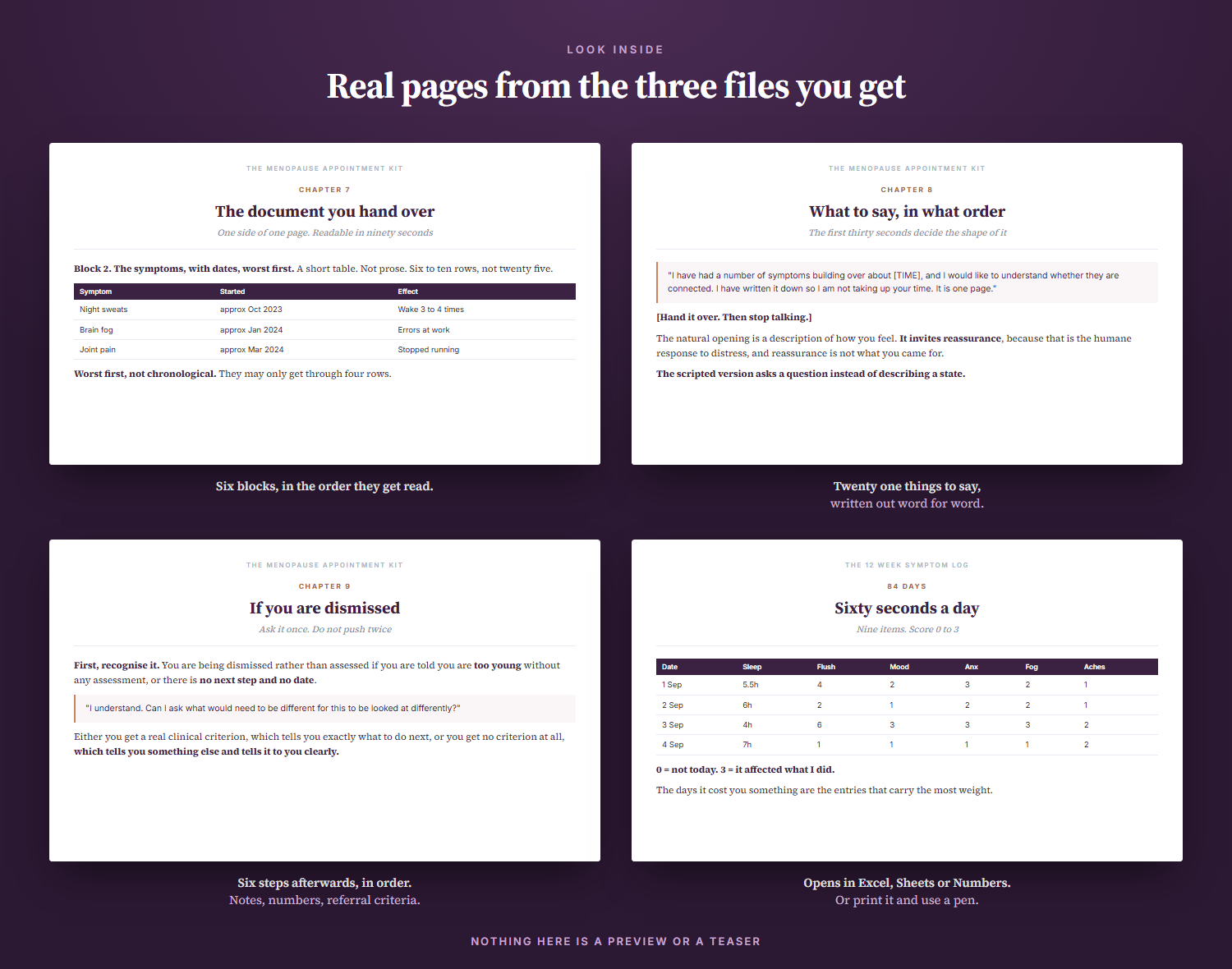
- Four real pages from the kit are above, at the size you will actually read them, taken out of the finished file rather than mocked up.
- The complete contents is on this page. Every chapter title, in order, so you can see what is not in it as well as what is.
- Every statistic here is listed at the bottom with its source, its year and how many people were surveyed. Two of them link to the original study.
- The price is 19 dollars and there is nothing after it. No subscription, no upsell, and no second product waiting on the next screen.
When there are real reviews they will go here, with the month each one was written, and the page will say how many people have bought it. Until then this section stays as it is.
Read this before you buy
This kit does not tell you what treatment to have. It does not recommend, discourage or assess any treatment, including hormone therapy, and it never will.
That is not a disclaimer bolted on the end. It is the whole design.
You have already read forty contradictory opinions online about what you should be taking. You do not need a forty first from a stranger who has never met you.
So if you are here for an answer about treatment, this is the wrong purchase and you should not make it. Nothing in these 42 pages will tell you what to take.
What it does is preparation, documentation and asking well. It turns three years of scattered symptoms into one page somebody can read in ninety seconds, gives you the questions in the order that works, and tells you exactly what to do if you are dismissed.
What happens after that is between you and your clinician. This only makes sure you get to have the conversation properly.
And it will not make the system faster. One third of women wait at least three years, and preparation does not remove that. What it does is make each appointment count for more, so that six visits build on each other instead of each one starting from nothing.

Nineteen dollars
Eighteen per cent of women visited their doctor six times before they got the help they needed.
The kit costs less than the parking for those six visits.
Here is exactly what you get for 19 dollars
- The Menopause Appointment Kit. 42 pages, 12 chapters, 8,281 words
- The one page template. Six blocks, in the order a clinician reads them
- 21 things to say, word for word. Including the one question if you are dismissed
- Ten questions on printable cards. Appendix C
- The Appointment Pack. 7 pages to print and take with you
- The 12 week symptom log. 84 days, 15 columns, sixty seconds an evening
- The twenty minute reconstruction method. For dates you never wrote down
- Yours to keep. Three files on your own device. No account, no expiry, no subscription
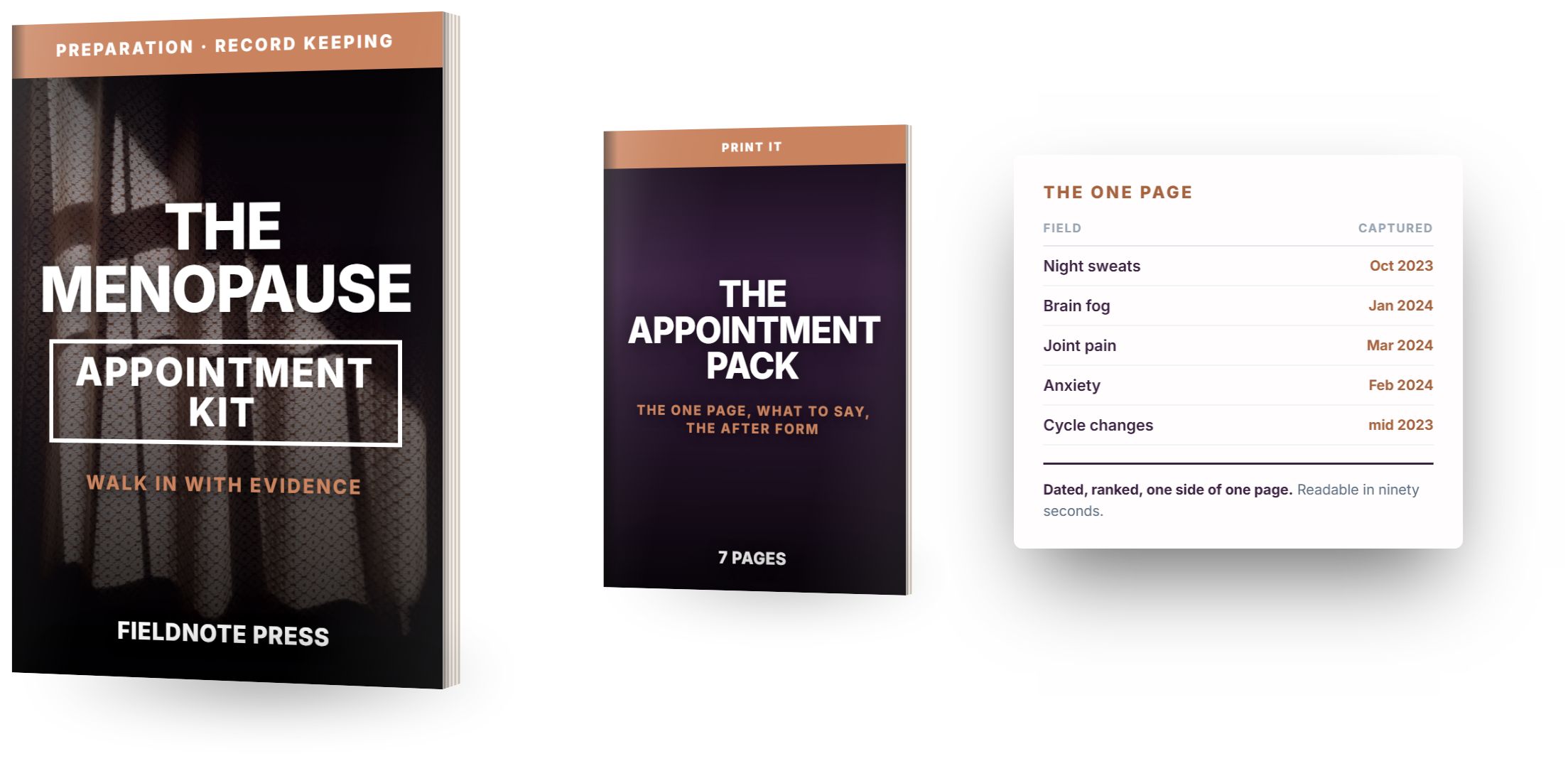
The Menopause Appointment Kit, 42 pages, PDF
The Appointment Pack, 7 pages, built to be printed
The 12 week symptom log, 84 days, CSV
Instant download. No app, no login, no subscription.
There is no refund on this, and saying so here is fairer than burying it in the terms. The whole thing arrives in about forty seconds, and a file that is already on your computer cannot meaningfully be returned. A refund offer on a downloaded PDF is theatre, so this page does not perform one.
What that obliges me to do instead is show you the product before you pay for it, which is what most of this page is:
- Four real pages from the kit, further up, at the size you will read them.
- Every chapter title, all twelve, plus the four appendices. You can see what is not in it as well as what is.
- A section on who should not buy this, which is directly above this box.
- Every statistic sourced, with its year and sample size, at the foot of the page.
If any of that leaves you unsure, the right decision is not to buy it. Nineteen dollars is not worth a purchase you feel uneasy about, and I would rather you closed the tab than felt sold to.
A download that fails or a link that expires is a different matter entirely and it gets fixed. Write to hello@lanternpathbooks.com with your receipt and you will get the files.
Questions
What format is it, and how fast do I get it?
PDF, three files. The kit, the printable Appointment Pack and the symptom log CSV. The download link appears the moment you pay and is emailed to you as well. No app, no account, no login.
My appointment is in three days. Is it too late?
No. Chapter 5 is the fourteen day version and chapter 6 is a twenty minute method for reconstructing a symptom history you never recorded, using anchor dates, old photographs and your own text messages. You can build a genuinely useful one page from memory alone. Do not delay an appointment you have already waited for in order to collect a longer log.
Does it tell me whether I should be on HRT?
No, deliberately, and it never will. It takes no position on any treatment. It prepares you for the conversation. It does not have the conversation for you and it does not tell you how it should end.
Does this work outside the UK, or the US?
Yes. Nothing in it depends on one health system. It is about recording symptoms, building the one page, what to say, and what to do if you are dismissed, and those are the same in any system with short appointments. The glossary explains the terms you will hear either way.
Is this medical advice?
No. It does not diagnose, treat or recommend treatment for anything. It is a preparation and record keeping tool. Decisions about investigation and treatment are for you and a qualified clinician.
I have already been dismissed twice. Is there any point?
Read chapter 9, which is the one on being dismissed, then start the log. Going back with a dated record is a different event from going back to try again. And 18% of women visited their doctor six times before they got the help they needed, which means persisting is a documented path rather than evidence that you were wrong.
Who wrote this, and are they a doctor?
Lantern Path Books, a small independent publisher, and no, the author is not a clinician. The kit never suggests otherwise. That is the design rather than a gap in it: somebody with a medical background writing this would be pulled towards telling you what to take, and the entire usefulness of the kit is that it refuses to. What it needed instead was the published research on how these appointments actually go, which is cited in full at the bottom of this page, and then the preparation that follows from it written down properly. For medical opinion you want your clinician. This exists to make that ten minutes work harder.
Are there reviews from people who have used it?
No, and there is a section on this page explaining why rather than hiding it. It went on sale in August 2026, so nobody has had a next appointment yet. Real reviews will be added here when they exist, dated. In the meantime the four sample pages, the full contents list and the cited sources are all things you can check without taking anyone's word for it, before you pay rather than after.
Why is it only 19 dollars?
Because it is a file, so it costs nothing to make another copy, and because the realistic alternative for most people is buying nothing and going in unprepared again. It is priced to be an easy decision at the point where you are already frustrated, not to signal that it is valuable. If the price is the thing making you hesitate, read the contents list above and decide from that instead. Sales are final, so it is worth the two minutes.
Can I get a refund if I change my mind?
No. These are digital files that download immediately and cannot be returned, so all sales are final, and this page says so rather than leaving you to find it in the terms. That is the reason the full contents, four real pages and a section on who should not buy it are all published above. Decide from those. A download that fails or a link that expires is a separate matter and will always be fixed. Nothing here removes any right you have under the consumer law of your own country.
How can I pay?
Apple Pay, Google Pay, or any credit or debit card. The payment page is hosted by Stripe, so your card details are entered on Stripe and never touch this site or reach us. On a phone the wallet options are usually one tap, with no typing at all.
What happens to my email address?
It is used to send your download link and your receipt. It is not sold, not rented, and not added to a marketing list you did not ask for. Full detail is in the privacy notice.
What if the download does not work?
Email hello@lanternpathbooks.com with your receipt and you will get the files sent directly. The download link is also re-sent to you by email at the moment of purchase, so a closed browser tab does not lose it.
Can I buy it for someone else?
Yes. Buy it, then forward them the download email. Chapter 12 is written specifically for the person helping, and the most useful part of it is not medical.
Where every number on this page comes from
Four sources, listed so you can go and read them rather than take this page's word for it.
- North American Menopause Society, 2021 survey. 61% of women said their doctors dismissed or downplayed their menopause symptoms. 46% said they were given no information or treatment at all. Widely reported; no open link to the survey document itself, so it is named here rather than linked.
- Kindra with The Harris Poll, July 2023. Women aged 45 to 54.
Around 1 in 3 had been diagnosed with a different condition by a healthcare provider before learning that menopause was causing the symptoms. 60% did not find their doctor's advice helpful. 32% were worried their provider was not knowledgeable about menopause.
ourkindra.com/blogs/journal/menopause-medical-misdiagnosis - Newson Health Research and Education, survey of 5,000 women. One third waited at least three years for symptoms to be correctly identified as menopause related. A further 18% visited their doctor six times before getting the help they needed. 1 in 4 who sought help were turned away, and told to come back when it got worse or when their periods had stopped for good. Reported widely in UK health coverage; named here rather than linked for the same reason as reference 1.
- Kling JM and colleagues. Menopause Management Knowledge in Postgraduate Family Medicine, Internal Medicine, and Obstetrics and Gynecology Residents: A Cross-Sectional Survey. Mayo Clinic Proceedings, February 2019, volume 94, issue 2, pages 242 to 253.
183 residents responded, across 20 United States residency programmes. 12 of 177 (6.8%) reported feeling adequately prepared to manage women experiencing menopause. 36 of 177 (20.3%) had received no menopause lectures during residency.
doi.org/10.1016/j.mayocp.2018.08.033
What these four sources do not show, stated because it matters.
Three of them are self reported surveys of women in the United Kingdom and the United States, so the exact percentages will not transfer perfectly to every country or every practice. The fourth is a survey of doctors in training in the United States, which is the best available evidence on how much menopause teaching medical education contains. It is not a measurement of the particular clinician you are going to see, who may well be excellent at this.
And none of these numbers is a claim about this kit. They describe the problem it was written for. No study has measured what happens when a woman walks in with a prepared one page document, and this page will not pretend otherwise. What is being offered is preparation, and the evidence that preparation is the sensible response to the situation above.
42 page kit, 7 page printable pack, 84 day symptom log. Instant PDF.
Apple Pay, Google Pay or any card.
Instant download. One payment, nothing after it.
You cannot control who you get, or how long you get.
You can control whether it is written down and in their hand.
This kit is not medical advice. It does not diagnose, treat or recommend treatment for any condition, and it takes no position on any treatment including hormone therapy. It is a preparation and record keeping tool. Decisions about investigation and treatment are for you and a qualified clinician. If you have symptoms that concern you, particularly any sudden or severe symptom, contact a medical professional or emergency service rather than a book.